
Collaborators: Maurício Nogueira, Cecília Banho, Beatriz Marques, Livia Sacchetto, Ana Karoline Lima, Maisa Carla Parra, Alex Lima, Gabriela Ribeiro, Antonio Martins, Claudia Barros, Maria Elias, Sandra Sampaio, Svetoslav Slavov, Evandra Rodrigues, Elaine Santos, Dimas Covas, Simone Kashima, Ricardo Brassaloti, Bruna Petry, Luan Clemente, Luiz Coutinho, Patricia Assato, Felipe Costa, Jayme Souza-Neto, Rejane Grotto, Mirele Poleti, Jessika Lesbon, Elisangela Mattos, Heidge Fukumasu, Marta Giovanetti, Luiz Carlos Alcantara, Paula Rahal, João Araújo, Fernando Spilki, Benjamin Althouse, Nikos Vasilakis
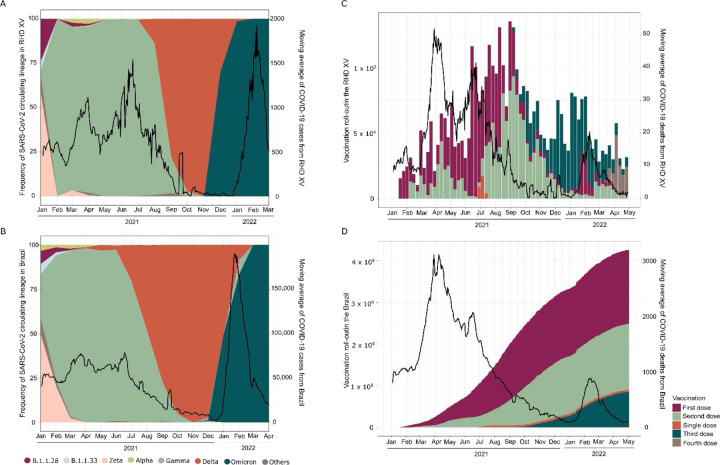
Summary: Since 2021, the emergence of variants of concern (VOC) has led Brazil to experience record numbers of in COVID-19 cases and deaths. The expanded spread of the SARS-CoV-2 combined with a low vaccination rate has contributed to the emergence of new mutations that may enhance viral fitness, leading to the persistence of the disease. Due to limitations in the real-time genomic monitoring of new variants in some Brazilian states, we aimed to investigate whether genomic surveillance, coupled with epidemiological data and SARS-CoV-2 variants spatiotemporal spread in a smaller region, can reflect the pandemic progression at a national level. Our findings revealed three SARS-CoV-2 variant replacements from 2021 to early 2022, corresponding to the introduction and increase in the frequency of Gamma, Delta, and Omicron variants, as indicated by peaks of the Effective Reproductive Number (Reff). These distinct clade replacements triggered two waves of COVID-19 cases, influenced by the increasing vaccine uptake over time. Our results indicated that the effectiveness of vaccination in preventing new cases during the Delta and Omicron circulations was six and eleven times higher, respectively, than during the period when Gamma was predominant, and it was highly efficient in reducing the number of deaths. Furthermore, we demonstrated that genomic monitoring at a local level can reflect the national trends in the spread and evolution of SARS-CoV-2.
Publication Date: 2024-01-22
Journal:
DOI: https://doi.org/10.21203/rs.3.rs-3788142/v1